EN



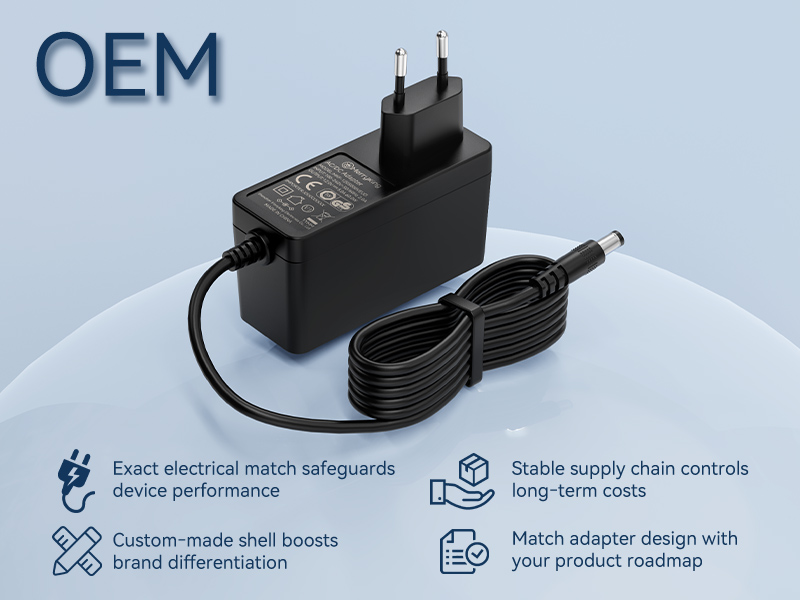
A standard adapter is designed for a range of applications, so its output tolerance, ripple, and protection thresholds are set conservatively. A custom power adapter is designed around your load: the output voltage and current match your device's requirement exactly, the ripple specification suits your sensitive electronics, and the protection settings are tuned to your failure modes. For a device that runs 24 hours a day, such as a security camera or a communication module, the thermal design can be validated for continuous duty instead of assumed. The result is fewer field failures, fewer warranty claims, and a better user experience, all of which are direct costs avoided over the product's life. When the adapter is the component that keeps your device alive, matching it to the load is not a luxury.
In retail and commercial channels, the power adapter is visible to the end customer. A custom housing with your logo, your color, and your packaging makes the product look complete and credible, and it prevents a competitor from selling an identical adapter alongside yours. Customization options such as logo silk-screen printing, laser engraving, and color-matched enclosures turn a commodity accessory into a branded component. Beyond appearance, a custom connector and cable length can improve the unboxing experience and reduce installation issues. For OEMs that sell through distributors, the branded adapter also strengthens the shelf identity of the product line. These are soft benefits, but they matter in markets where the accessory is part of the purchase decision.
Working directly with the factory on a custom power adapter gives the OEM control that a catalog purchase cannot provide. The design, the components, and the test plan are documented and owned by your program, so the product does not change when the factory updates its standard line. You can define the quality plan, including the 100% aging test on every unit and the AQL sampling level, and the test reports become part of your incoming inspection. Long-term cost is also more predictable when the design is fixed: material changes are visible and agreed, and volume tiers apply to your program rather than to a generic catalog product. For a product family that ships for years, the custom adapter turns a variable commodity into a managed supply.
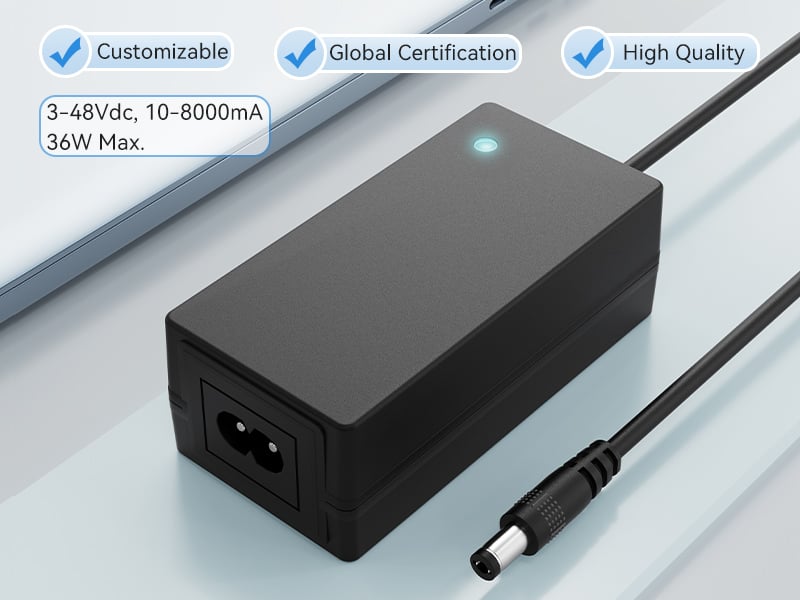
A custom power adapter should be planned like any other long-lead component in your product roadmap. If you know that the next product generation will use a higher power level or a different connector, share that direction with the factory so the design can accommodate future variants without starting from zero. Agree on how design changes are requested and documented, and keep the specification and test reports in a controlled file that travels with the product. When the roadmap changes, the factory can evaluate the impact on tooling, certification, and unit cost before you commit, instead of discovering it during a crisis. This planning discipline is what separates OEM programs where the custom adapter is an asset from those where it becomes a recurring negotiation point.
An OEM was developing a payment terminal for a retail customer base. The first prototype used a standard 24V adapter, but the terminal's credit-card reader was sensitive to ripple, and the standard model occasionally caused communication errors under load. The OEM moved to a custom power adapter with a tightened ripple specification, a locked connector that resisted tampering, and a branded housing matching the terminal's design language. The unit price was slightly higher than the standard adapter, but the field failure rate dropped, the customer accepted the terminal more quickly, and the branded adapter reinforced the product line across multiple distributor channels. The OEM calculated the investment against avoided warranty claims and found that the custom power adapter paid for itself within the first production year. This scenario is typical of OEM projects where the adapter is small in cost but large in influence on the product's reputation.
A custom power adapter is not the right answer for every OEM project. If your device has a common voltage and current, if the volume is low, or if the product is a one-time run, a standard model with an existing certificate is faster and cheaper. The rule of thumb is to compare the total program cost: if the one-time tooling and certification costs cannot be amortized across enough units, the standard adapter wins. Also consider the market timeline, because a custom program adds development and certification time to your schedule. The practical approach is to evaluate the standard option first, document the gaps it creates in performance, branding, or reliability, and then decide whether those gaps justify the custom investment. Many OEMs start with a standard model for the first batch and move to a custom adapter when volume and market feedback justify it.
When does a custom power adapter make sense for an OEM?
It makes sense when your device has specific electrical, thermal, or branding requirements that a standard adapter cannot meet, and when the order volume is large enough to amortize the one-time tooling and certification costs. For high-volume product families, the custom adapter usually pays for itself within the first production year.
What are the risks of using a standard adapter in an OEM product?
The main risks are performance mismatches, such as ripple that disturbs sensitive circuits or a thermal design not validated for continuous duty, plus the absence of brand differentiation and less control over design changes in the factory's standard line.
Can I start with a standard adapter and switch to a custom one later?
Yes. Many OEMs launch with a standard model to validate the market, then move to a custom adapter when volume grows. Keep the specification document from the start so the transition to a custom design is based on measured data rather than guesswork.