EN




When designing specialized electronic equipment, engineering teams often face a critical decision: whether to integrate a standard, off-the-shelf power supply or invest in a custom ac adapter. While off-the-shelf units may seem convenient for initial prototyping, they frequently fail to meet the exact electrical output parameters required by advanced medical devices, precision industrial instruments, or high-end telecommunications hardware. Off-the-shelf power supplies are typically engineered for generic, broad-market applications, meaning their voltage regulation, ripple current suppression, and transient response capabilities might not align with your device's sensitive circuitry. By opting for a bespoke power solution, engineers can precisely dictate output voltages, current limits, and protection features—such as over-voltage, short-circuit, and over-temperature safeguards—ensuring that the power source operates in absolute harmony with the host equipment. This precision eliminates performance bottlenecks, prevents premature component degradation, and safeguards the functional integrity of your technology from day one.
Beyond raw electrical metrics, physical integration and mechanical form factor constraints present major hurdles that standard power supplies rarely accommodate. Commercial off-the-shelf adapters come in fixed enclosures with predetermined dimensions, weight distributions, and AC plug orientations that may clash with your product's internal spatial layout or external industrial design. A custom ac adapter, however, can be tailored in every physical dimension, from ultra-slim casing profiles and specialized PCB layouts to custom wire harness lengths, specific DC connector types, and dedicated desktop or wall-mount housing configurations. In practical field applications, field engineers frequently encounter tight enclosure tolerances where a standard brick-style adapter simply will not fit or creates severe thermal management issues due to restricted airflow. Customizing the enclosure material, thermal dissipation pads, and physical mounting points ensures seamless mechanical integration, elevating the final product's aesthetic appeal, user convenience, and structural durability.
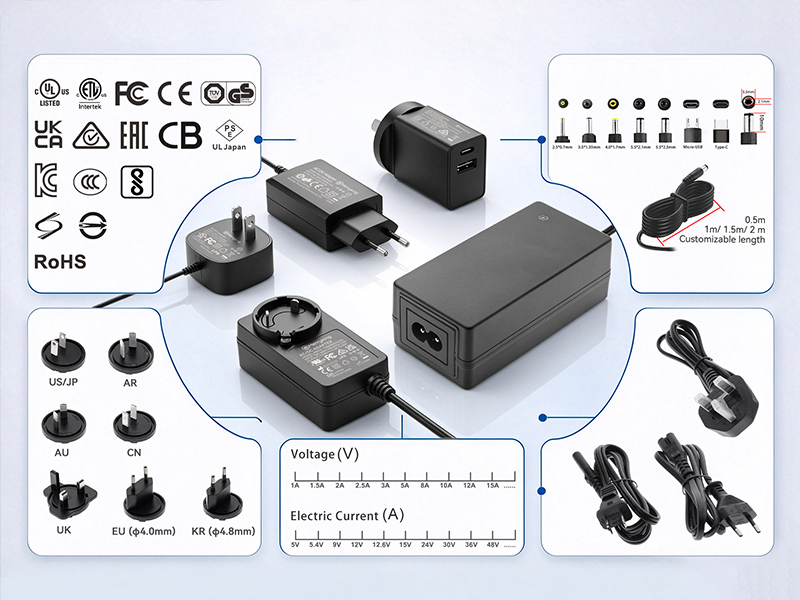
Navigating international regulatory frameworks and safety certifications represents another compelling justification for bespoke power supply development. Mass-market, generic adapters often carry broad certifications, but they may lack the specific regional safety approvals required for your target export markets, such as UL and FCC for North America, CE and UKCA for Europe, PSE for Japan, or SAA for Australia. Attempting to force a generic adapter into a highly regulated application can trigger severe customs clearance delays, expensive re-testing fees, or outright rejection by retail and industrial compliance authorities. Partnering with an experienced manufacturer to engineer a custom ac adapter guarantees that all safety marks, electromagnetic compatibility (EMC) standards, and energy efficiency protocols—such as DOE Level VI or CoC Tier 2 eco-design requirements—are embedded directly into the design phase. This proactive compliance strategy ensures smooth global market entry without the administrative nightmare of retrofitting uncertified hardware.
Looking at the broader economic and operational picture, custom power solutions frequently deliver superior long-term value compared to off-the-shelf alternatives. Although generic units appear inexpensive upfront, they carry hidden lifecycle risks, including sudden component obsolescence by third-party manufacturers, inconsistent batch quality, and lack of dedicated technical support when field failures occur. When you collaborate with a specialized factory to develop a custom ac adapter, you secure complete supply chain stability, guaranteed component longevity, and direct engineering change-management control. Furthermore, optimizing the power unit specifically for your load profile reduces energy waste, lowers internal operating temperatures, and significantly extends the operational lifespan of your primary device. Over time, eliminating field returns, reducing warranty claims, and avoiding emergency redesigns transforms the initial customization investment into a strategic financial advantage, cementing your brand's reputation for uncompromising quality and reliability.