EN



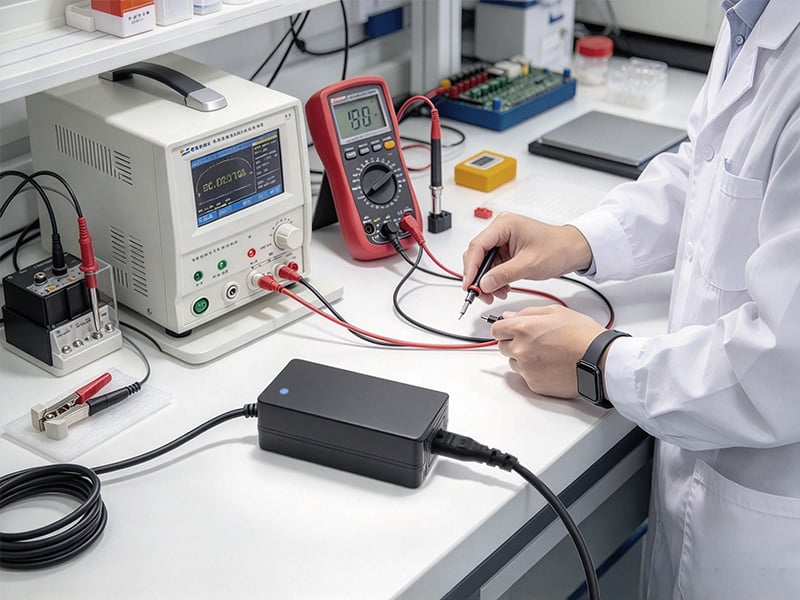
Embarking on the journey of developing a bespoke power solution requires a structured, multi-stage engineering roadmap to ensure that the final product aligns perfectly with your hardware's requirements. The development process begins with a comprehensive requirement analysis, where engineering teams translate device load profiles, input voltage ranges, and environmental constraints into precise electrical parameters. Whether designing for sensitive medical instruments or robust industrial automation systems, defining the exact output voltage, ripple current limits, and protection thresholds—such as over-voltage, short-circuit, and over-temperature safeguards—sets the critical baseline. During this initial phase, partnering with an experienced custom power adapter manufacturer ensures that potential bottlenecks are identified early, avoiding costly redesigns later in the project lifecycle.
Once the electrical and mechanical specifications are locked, the project transitions into schematic design, PCB layout, and physical prototyping. Engineering teams construct preliminary circuit boards and mechanical enclosures, tailoring the form factor, wire harness length, and connector type to fit the target device's internal layout or external industrial design. Rigorous laboratory testing follows immediately, focusing heavily on thermal validation under continuous full-load operating conditions and component stress analysis. A reliable custom power adapter must undergo thorough testing to verify that internal component temperatures remain within safe operating limits, even during prolonged use in restricted-airflow environments. This prototyping stage allows developers to refine circuit efficiency, minimize electromagnetic interference (EMI), and verify that transient response capabilities meet the stringent demands of high-performance electronics.
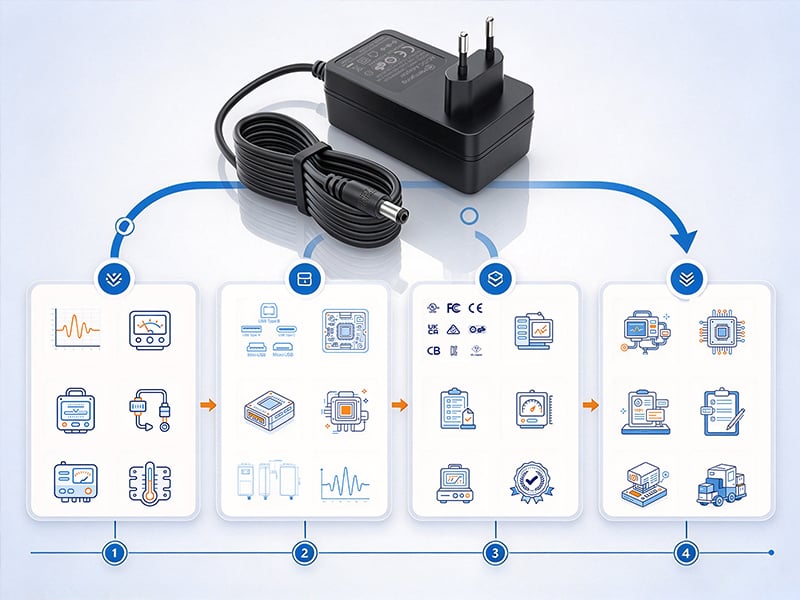
Navigating international regulatory frameworks and securing necessary safety certifications represent an indispensable milestone in the development cycle. Mass-market power supplies often lack specific regional approvals, but a dedicated custom power adapter project must be engineered from the ground up to comply with global standards such as UL and cUL for North America, CE and UKCA for Europe, PSE for Japan, and SAA for Australia. Furthermore, energy efficiency protocols—including DOE Level VI and CoC Tier 2 eco-design requirements—are integrated directly into the circuit design. Submitting pre-production prototypes to accredited compliance laboratories ensures that electromagnetic compatibility (EMC) and electrical safety tests are passed smoothly, preventing customs clearance delays and enabling confident global market entry.
The final phase of development shifts focus toward mass production scalability, quality assurance, and seamless supply chain delivery. Transitioning from prototype approval to full-scale manufacturing requires strict control over component sourcing, ensuring that high-frequency transformers, control ICs, and electrolytic capacitors maintain consistent, high-tier batch quality. Before any shipment leaves the facility, a robust custom power adapter must undergo mandatory 100% full-load aging tests and comprehensive Acceptance Quality Limit (AQL) sampling inspections. Establishing clear traceability records, stable warranty frameworks, and predictable volume pricing guarantees long-term operational success. By treating development, compliance, and manufacturing as a unified, systematic workflow, OEMs can transform custom power supply development into a strategic asset that enhances product reliability and brand reputation.