EN
EN



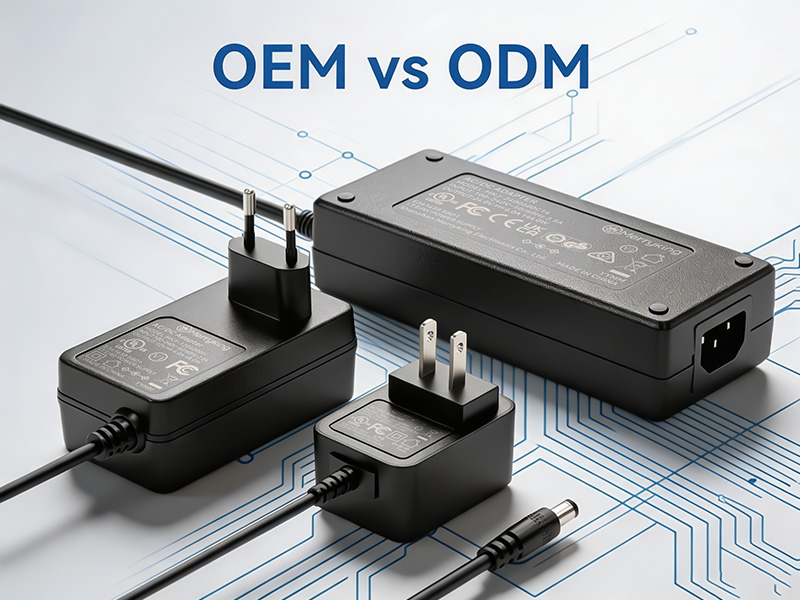
Navigating the power supply supply chain requires understanding whether Original Equipment Manufacturing (OEM) or Original Design Manufacturing (ODM) fits your business strategy. In OEM sourcing, your business provides exact technical blueprints, industrial housing designs, circuit board layouts, and component specifications. The factory executes assembly, rigorous quality control, and functional testing according to your proprietary documentation. Conversely, under an ODM framework, the manufacturer provides turn-key solutions—utilizing their in-house research and development to produce pre-certified units that can be customized with your branding, DC connector variations, and external enclosure logos. For companies launching specialized hardware, selecting a custom power adapter manufacturer depends on whether you possess fully engineered schematic designs or require an experienced engineering team to design circuit topology from scratch.
Engineering decisions during power supply procurement directly impact your capital allocation and time-to-market. Developing a custom OEM power adapter unit involves significant initial engineering fees, including custom plastic injection molds, transformer winding design, printed circuit board (PCB) masking, and prototype testing. This development cycle typically spans 8 to 16 weeks before mass production commences, requiring higher Minimum Order Quantities (MOQ) to amortize fixed tooling costs. On the other hand, selecting an ODM power adapter model allows brands to bypass heavy initial research and development investments. ODM suppliers maintain existing, field-tested platforms with established PCB layouts and housing molds. This streamlined approach shortens product launch timelines to 2 to 4 weeks while offering lower MOQ thresholds, making it an ideal strategy for small-to-medium enterprises and fast-moving consumer electronics lines.
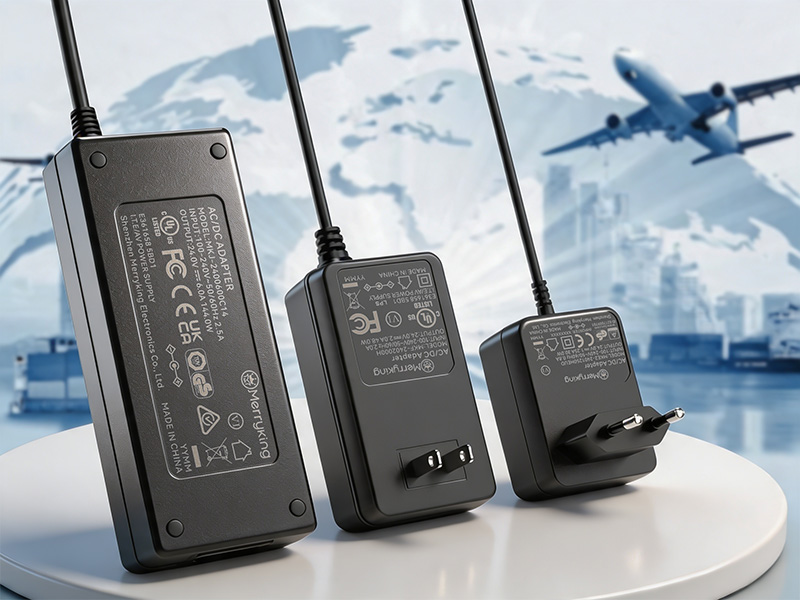
Whether choosing OEM or ODM manufacturing, verifying electrical safety compliance remains paramount to protect hardware reliability and avoid regulatory compliance issues at customs. High-quality production partners like Shenzhen Merryking Electronics many AV/ICT power adapter platforms can be designed to meet IEC 62368-1 or its national equivalents, depending on the model and intended application. for audio, video, and information technology equipment. OEM projects require funding full compliance testing cycles from scratch to acquire certifications under your corporate name. In contrast, ODM solutions allow brands to leverage the factory's existing global test reports—including UL and ETL for North America, CE-LVD and CE-EMC for Europe, UKCA for Great Britain, PSE for Japan, KC for Korea, and BIS for India. Premium factories ensure built-in circuit protection mechanisms, such as Over-Voltage Protection (OVP), Over-Current Protection (OCP), Over-Temperature Protection (OTP), and Short-Circuit Protection (SCP), guaranteeing stable operation across global AC grids.
Evaluating long-term supplier viability requires auditing factory manufacturing capabilities, energy efficiency compliance, and quality control systems. A top-tier power adapter manufacturer should offer versatile form factors—including wall-mount, interchangeable plug, and desktop configurations—capable of delivering output ranges from 3W up to multi-hundred-watt capacities. Energy efficiency is equally critical: modern production lines must comply with global green energy standards, such as US DOE Level VI and European CoC Tier 2, achieving operating efficiency between 87% and 92% with no-load power consumption below 0.1W. During supplier site audits, procurement teams should inspect automated SMT production lines, burn-in aging rooms, high-voltage withstand insulation testers, and automated optical inspection systems to ensure consistent build quality across every production batch.
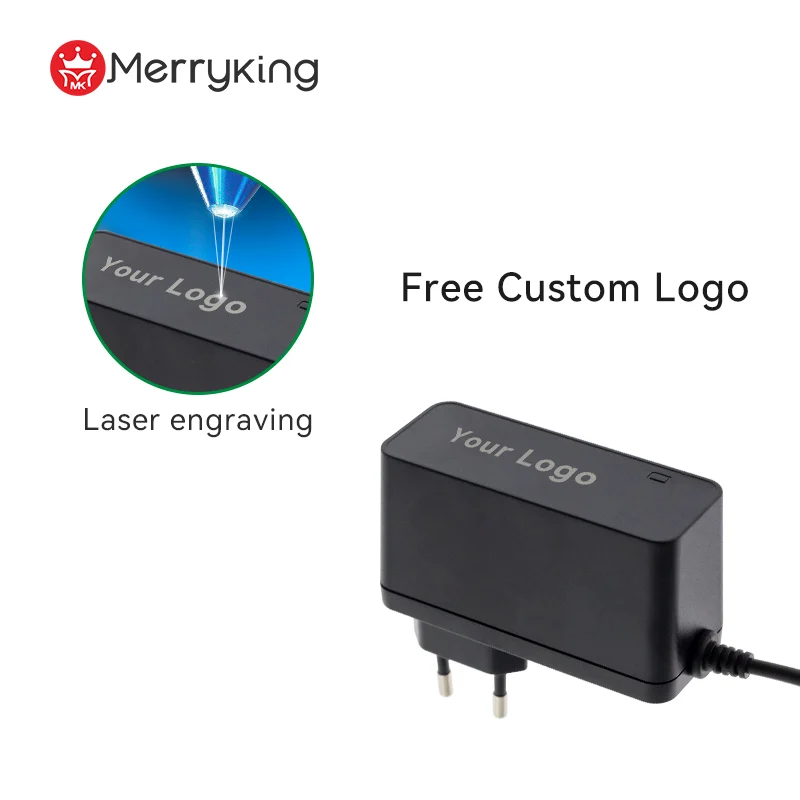
Which model is better for a startup launching a new hardware product: OEM or ODM?
For most startups, ODM is the faster and more cost-effective choice. It eliminates expensive plastic mold development and PCB design costs while leveraging pre-certified platforms from factories like Shenzhen Merryking Electronics, drastically reducing time-to-market.
Can I modify the DC plug size and cable length on an ODM power adapter?
Yes, absolutely. ODM solutions allow extensive secondary customization, including modified DC barrel plug dimensions (such as 5.5x2.1mm or 5.5x2.5mm), custom cable lengths, custom casing colors, private label branding, and region-specific AC wall plugs (EU, US, UK, AU, etc.).
How do I verify if an OEM/ODM factory's safety certifications are authentic?
Always request the factory's official third-party test reports and certificate numbers (e.g., UL, CE, PSE, KC). You can verify these certificate numbers directly on official testing laboratory databases (such as UL Solutions Directory) to ensure they match the manufacturer's name and model numbers.