EN
EN



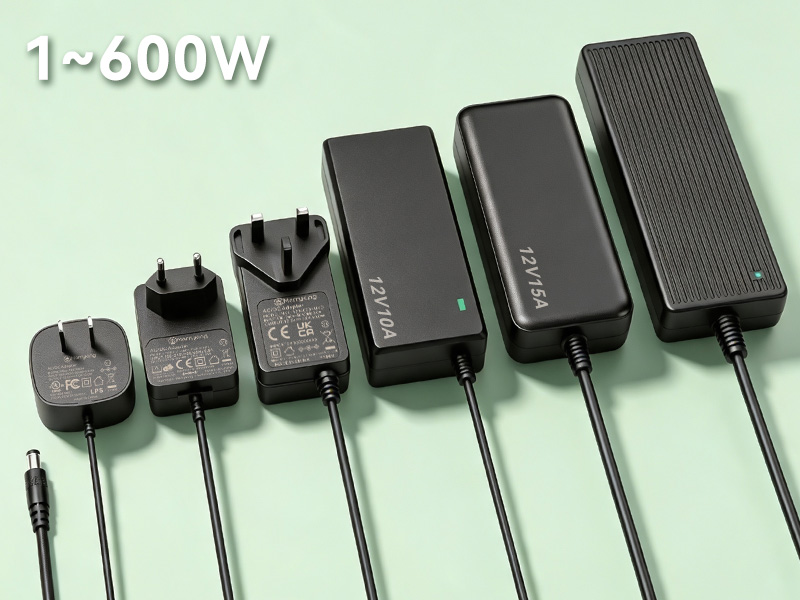
Selecting the correct power supply begins with reading your hardware's rating label or bottom enclosure. The primary engineering rule for device safety is matching output voltage exactly to input voltage. If your device specifies 12V DC, connecting a 19V supply will permanently destroy internal components, while a 5V unit will fail to power up the system. Amperage operates on a different rule: your electronic equipment only draws as much current as required. Therefore, a replacement power adapter must equal or exceed the original amperage rating. For example, if your device requires 12V 2A (24W), choosing a 12V 3A (36W) power adapter is completely safe and beneficial. The additional capacity provides thermal headroom, keeping the power adapter cool during peak operating loads and preventing premature thermal degradation.
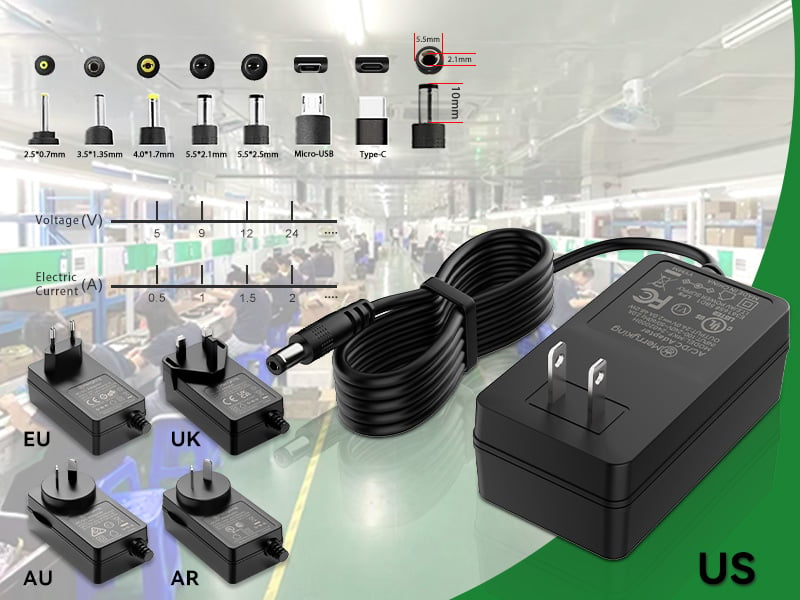
Even when electrical parameters match, a power supply cannot deliver energy without the right physical connection. Many low-to-medium power devices use DC barrel connectors, but USB-C, terminal blocks, DIN connectors, and proprietary connectors are also common, but inner and outer dimensions vary. Common barrel sizes include 5.5mm x 2.1mm and 5.5mm x 2.5mm options. In practical engineering, inserting a 2.1mm plug into a 2.5mm jack creates loose contacts, intermittent power drops, or electrical arcing under movement. Polarity verification is equally vital. Center-positive polarity—indicated by a diagram showing a solid circle connecting to a plus sign—is standard across consumer electronics. Plugging a center-negative power adapter into a center-positive port without reverse polarity protection creates immediate short circuits, damaging sensitive microcontrollers within your hardware.
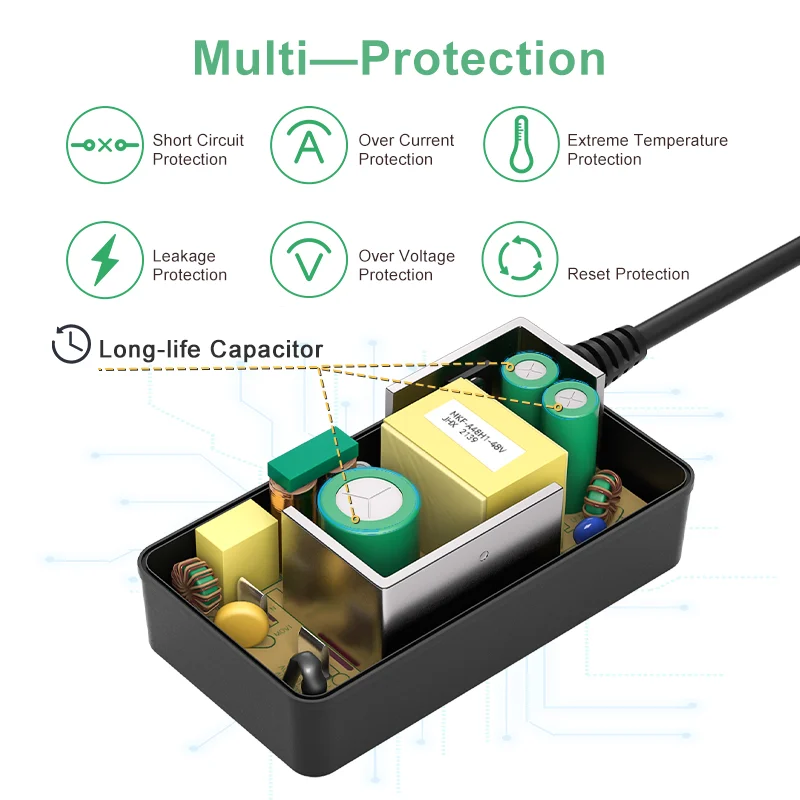
A high-quality power supply serves as a protective shield between unpredictable AC wall grids and sensitive electronics. During supplier audits, procurement managers verify third-party test reports rather than unverified logos. Premium power supply designs from suppliers like Shenzhen Merryking Electronics integrate vital internal protection circuits, including Over-Voltage Protection (OVP), Over-Current Protection (OCP), Over-Temperature Protection (OTP), and Short-Circuit Protection (SCP). These safety circuits shut off power output during fault conditions to protect connected equipment. Additionally, products distributed internationally require verified safety certifications—such as UL and ETL for North America, CE-LVD and CE-EMC for Europe, UKCA for Great Britain, PSE for Japan, KC and KCC for Korea, and BIS for India—confirming compliance with the international safety standard IEC 62368-1.
Choosing the optimal power adapter requires selecting a form factor that fits your operational layout. Wall-mount units with fixed AC plugs (available in EU, US, UK, AU, CN, JP, KR, IN, and AR configurations) suit low-to-medium power devices like routers, set-top boxes, and security cameras. For global distribution, an interchangeable plug power adapter allows one body to accept snap-on regional plug heads, reducing stock-keeping unit (SKU) complexity across overseas markets. Desktop models with detachable AC power cords handle higher power demands up to multi-hundred watt outputs, such as industrial equipment and LED controllers. Furthermore, choosing a power adapter meeting DOE Level VI or CoC Tier 2 efficiency standards ensures over 87% to 92% operating efficiency and keeps no-load standby power below 0.1W, minimizing power consumption and extending hardware lifespan.
Can I use a power adapter with a higher amperage than my device requires?
Yes, absolutely. Devices only draw the current (amperes) they actually need. Using a power adapter with a higher current capacity (e.g., using a 12V 3A supply for a 12V 2A device) is completely safe, reduces heat strain on the adapter, and significantly extends its operating lifespan.
What happens if I plug in a power adapter with the wrong voltage?
Matching voltage is critical. If the replacement power adapter has a higher voltage than specified, it can permanently burn out internal components. If it has a lower voltage, the device will either not turn on or fail to operate stably under heavy processing loads.
Why are global safety certifications like UL, CE, and PSE so important for OEM sourcing?
International safety certifications prove that a power adapter has passed rigorous third-party safety testing under standards like IEC 62368-1. Choosing certified units from manufacturers like Shenzhen Merryking Electronics ensures electrical compliance, prevents fire hazards, and guarantees smooth customs clearance across international markets.