EN
EN



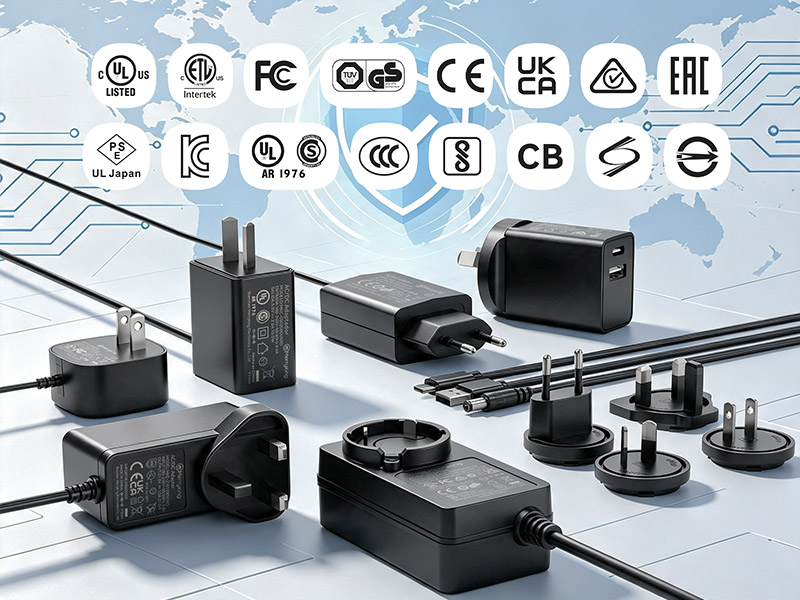
Navigating international trade regulations requires a clear understanding of electrical safety and electromagnetic compatibility (EMC) standards. For electronics manufacturers, hardware OEMs, and international buyers, sourcing a fully certified external power unit is the single most critical step in mitigating custom clearance risks, avoiding product recalls, and protecting end-user safety. Global market entry relies on strict adherence to harmonized safety frameworks, particularly the IEC 62368-1 international standard governing audio, video, and information technology equipment. Modern external power units must satisfy complex regulatory requirements across diverse geographic regions, ensuring that internal printed circuit board (PCB) layouts, creepage distances, and insulation barriers can withstand electrical grid fluctuations without causing electric shock or fire hazards. Sourcing from experienced manufacturers like Shenzhen Merryking Electronics ensures that every power adapter platform is pre-engineered to meet these global standards, providing built-in protection against over-voltage, over-current, over-temperature, and short circuits.
For brands entering the United States and Canadian markets, obtaining recognized North American safety marks is a legal and commercial necessity. The Underwriters Laboratories (UL) mark and the Electrical Testing Laboratories (ETL) mark represent compliance with crucial safety standards such as UL 62368-1. These certifications verify that a switching power supply has undergone rigorous electrical withstand, thermal endurance, and mechanical impact testing. In North America, power units must also comply with stringent energy efficiency mandates. The U.S. Department of Energy (DOE) Level VI efficiency standard requires wall-mount and desktop units to achieve high operating efficiency—typically between 87% and 92%—while maintaining an ultra-low no-load power consumption of less than 0.1W. Choosing a UL certification addresses safety. Energy-efficiency compliance, such as U.S. DOE requirements or California requirements where applicable, must be verified separately.
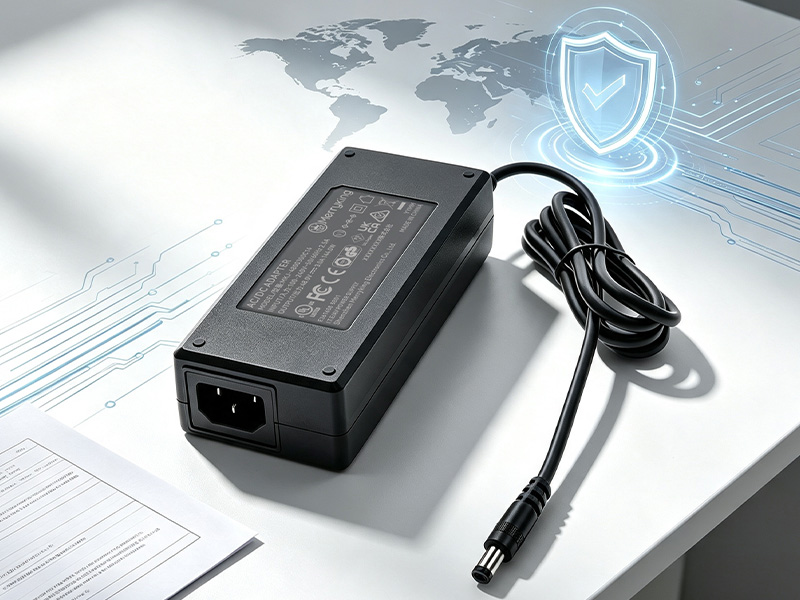
Exporting electronic hardware into the European Economic Area (EEA) and the United Kingdom demands strict compliance with regional directives. The CE mark in Europe is divided into two primary compliance vectors: the Low Voltage Directive (CE-LVD) for electrical safety and the Electromagnetic Compatibility Directive (CE-EMC) to ensure the device neither generates harmful radio interference nor succumbs to external electromagnetic disturbance. Following Great Britain's departure from the European Union, the UKCA (UK Conformity Assessed) mark became mandatory for products sold in England, Wales, and Scotland. Furthermore, European markets enforce demanding environmental and green energy protocols, including European CoC Tier 2 efficiency guidelines and RoHS/REACH substance restriction directives. High-quality production lines utilize flame-retardant PC/ABS enclosure materials and lead-free soldering processes to ensure every certified wall mount power adapter delivers safe, eco-friendly performance.
Expanding into key Asian markets involves satisfying distinct country-specific testing protocols and factory inspection schemes. In Japan, external power units fall under the Electrical Appliance and Material Safety Law (DENAN Law), requiring mandatory PSE (Product Safety Electrical Appliance & Materials) certification with specific diamond or circle marks based on product classification. In South Korea, the KC (Korea Certification) mark mandates both electrical safety testing (KC Safety) and electromagnetic compatibility testing (KC EMC) conducted by accredited Korean laboratories. Meanwhile, India's Bureau of Indian Standards enforces the mandatory BIS registration scheme under the Compulsory Registration Scheme (CRS) for electronics. Sourcing a versatile power adapter platform with existing global test reports allows brand owners to significantly streamline local registration processes, reducing regulatory approval timelines from months to just a few weeks.
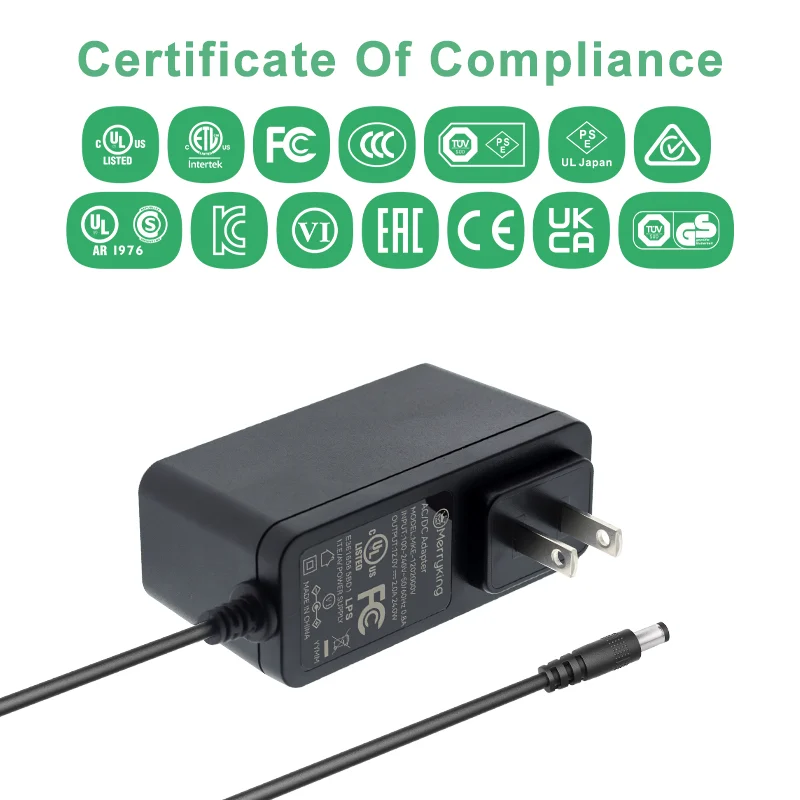
Ensuring long-term supply chain integrity requires procurement teams to actively verify factory test reports and certification authenticity before placing bulk orders. Counterfeit or invalid safety marks expose businesses to severe customs holds, legal liabilities, and reputational damage. To verify authenticity, buyers should request official test reports and certificate numbers, cross-referencing them directly on official testing laboratory databases such as the UL Solutions Directory or European notified body portals. A reputable supplier should maintain an updated portfolio covering universal AC input ranges (100V–240V AC), diverse form factors—including wall-mount, desktop, and interchangeable plug configurations—and complete test documentation. Partnering with a fully certified manufacturer guarantees consistent production quality, robust circuit protection, and seamless global distribution for your electronic devices.
What is the difference between UL listed and UL recognized marks on a power adapter?
A UL Listed mark applies to complete, stand-alone end-products like a complete desktop or wall-mount power adapter ready for consumer use. A UL Recognized mark applies to internal components or sub-assemblies designed to be integrated into larger manufactured systems.
Can a single power adapter carry multiple global safety certifications?
Yes. Premier manufacturers design universal power supply platforms with wide AC input ranges (100V–240V AC) that pass testing for multiple regional marks simultaneously, including UL, CE, UKCA, PSE, KC, and BIS, allowing a single product model to be sold globally.
Why is DOE Level VI efficiency compliance required alongside safety certifications?
While safety certifications like UL or CE prevent electrical hazards, energy efficiency standards like US DOE Level VI and European CoC Tier 2 are legally mandated environmental regulations designed to minimize power loss and reduce standby energy consumption below 0.1W.