EN



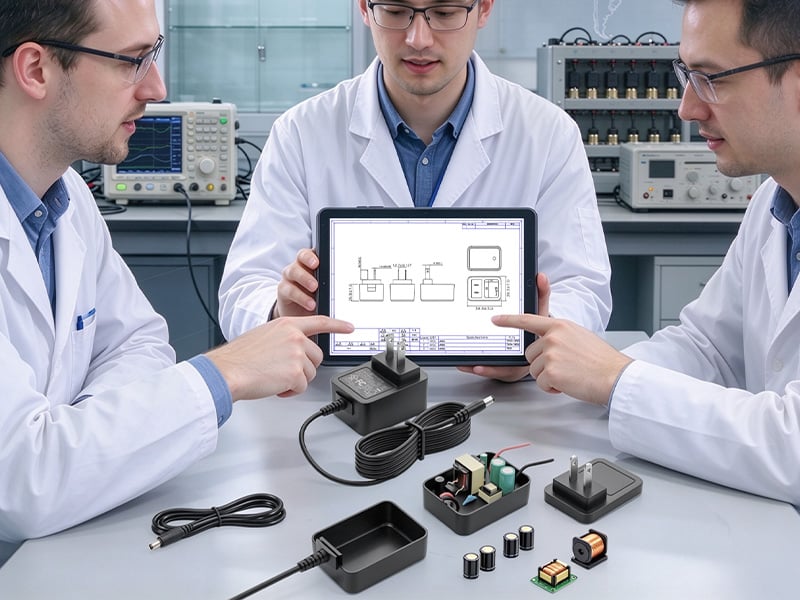
When hardware developers and engineering teams embark on the journey of creating a tailored power supply for specialized electronic equipment, one of the most pressing questions is always regarding the schedule. Specifically, determining the turnaround schedule for a custom ac adapter prototype is critical for aligning project roadmaps, budgeting, and commercial launch dates. Typically, the entire prototyping lifecycle spans anywhere from two to four weeks, depending heavily on the complexity of the electrical specifications, the availability of specialized electronic components, and the unique mechanical constraints of the target device. Establishing clear expectations during this initial phase prevents downstream delays and ensures that both the client and the manufacturing partner remain synchronized throughout the development cycle.
The process officially begins with a thorough requirement analysis and engineering review, which usually takes the first few days of the timeline. During this crucial window, application engineers evaluate device load profiles, input voltage ranges, output requirements, and safety protection thresholds such as over-voltage, short-circuit, and over-temperature safeguards. Once parameters are finalized, the project transitions into schematic design, bill-of-materials (BOM) compilation, and printed circuit board (PCB) layout. Sourcing core electronic elements—such as high-frequency transformers, control integrated circuits, electrolytic capacitors, and switching transistors—takes careful coordination. If standard components are readily available in stock, this phase moves swiftly, but specialized or high-end components may require extra sourcing lead time to guarantee that the power supply meets exact efficiency goals and regulatory expectations.
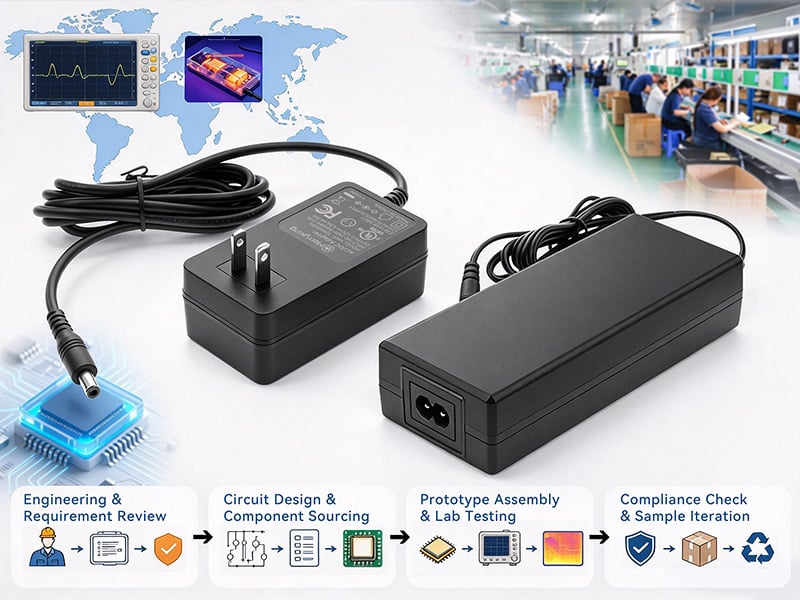
Following schematic sign-off and material readiness, the physical prototyping stage moves into high gear with circuit board surface-mounting, component soldering, and mechanical enclosure fabrication. Modern manufacturing facilities utilize advanced rapid prototyping tools to build initial samples that match the desired form factor, wire harness length, and connector types. However, assembling the physical hardware is only half the battle; rigorous laboratory testing must follow immediately. A professional custom ac adapter prototype undergoes strict thermal validation under continuous full-load conditions, ripple current measurements, and electromagnetic interference (EMI) preliminary scans. This testing ensures that internal operating temperatures remain well within safe limits and that transient response capabilities satisfy the demanding needs of sensitive medical instruments or industrial automation hardware.
The final stage of the prototyping timeline involves pre-compliance checks and sample dispatch to the client for evaluation. Before shipping the physical units, engineers verify that the design aligns with global safety frameworks and energy efficiency protocols, such as DOE Level VI or CoC Tier 2 eco-design requirements. Once internal quality checks are cleared, the prototype units are shipped to the client's engineering facility for on-site integration and functional testing. Any minor adjustments or fine-tuning requested by the client during this evaluation window can then be addressed rapidly, paving the way for smooth transition into mass production, 100% full-load aging tests, and AQL quality inspections.