EN
EN



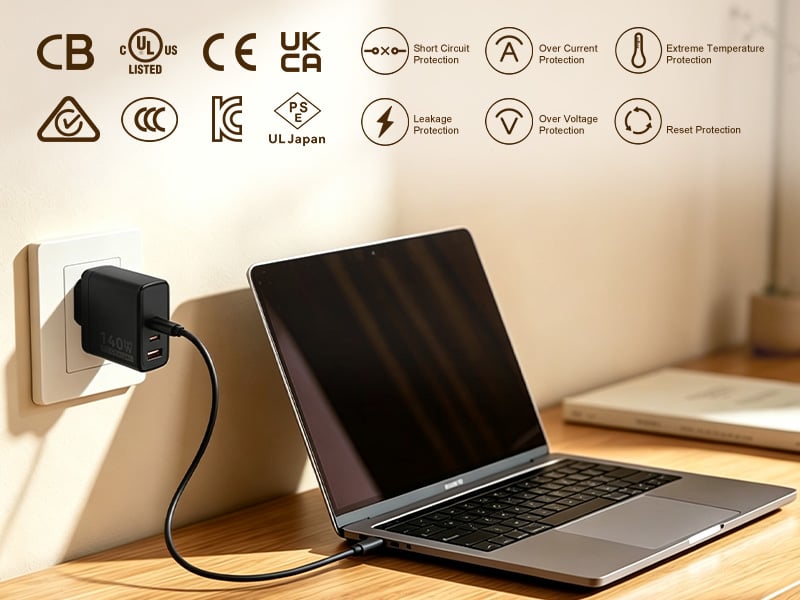
Every AC DC adapter that reaches the global market must comply with a framework of safety standards designed to protect end users from electrical hazards, fire risks, and electromagnetic interference. The foundational standard for modern audio-video, information-technology, and communication-technology equipment is IEC 62368-1, which replaced the older IEC 60950-1 and IEC 60065 standards. This hazard-based safety standard evaluates potential energy sources, fire enclosure requirements, and safeguards against electric shock. When buyers evaluate ac dc adapter safety standards, they are essentially verifying whether a supplier can demonstrate compliance with IEC 62368-1 and its national equivalents across target markets. A single adapter may need to carry certifications for North America (UL 62368, ETL), Europe (EN 62368-1, CE-LVD, CE-EMC), the United Kingdom (UKCA based on BS EN 62368-1), Japan (PSE), Korea (KC, KCC), Australia (SAA, RCM), and India (BIS), among others. Each certification confirms that the product passed independent laboratory testing for electrical safety, electromagnetic compatibility, and material flammability.
Different countries mandate distinct certification marks before an adapter can be legally sold or imported. UL and ETL certifications, both based on UL 62368, are essential for the North American market. The CE mark, comprising CE-LVD for the Low Voltage Directive and CE-EMC for electromagnetic compatibility, covers the European Union. The UKCA mark, tested to BS EN 62368-1:2014+A11:2017 under the UK Electrical Equipment (Safety) Regulations 2016, is required for Great Britain following Brexit. SAA and RCM apply to Australia and New Zealand, while PSE is mandatory for Japan. KC and KCC cover Korean safety and electromagnetic compatibility requirements. BIS certification is enforced for India, and S-MARK is needed for Argentina. Singapore requires PSB certification. Manufacturers who hold all sixteen of these certifications, such as Shenzhen Merryking Electronics, provide buyers with documented evidence that their adapters meet ac dc adapter safety standards across virtually every major consumer market, reducing the compliance burden for OEM customers who ship globally.
Beyond certification marks, the ac dc adapter safety standards framework mandates specific protection circuits within the adapter itself. Over-voltage protection (OVP) shuts down the output if the internal regulator fails and voltage exceeds a safe threshold, preventing damage to connected equipment. Over-current protection (OCP) limits current flow during a short circuit or overload condition. Over-temperature protection (OTP) monitors the internal temperature and reduces output or shuts down before thermal damage occurs. Short-circuit protection (SCP) immediately cuts output when a direct short is detected at the connector. These protections are verified during type testing, where the adapter is subjected to abnormal conditions including output short-circuits, component failures, and sustained overload. Dielectric strength testing, typically applying 3000V AC between primary and secondary circuits for one minute, verifies insulation integrity. Leakage current measurements confirm that no dangerous current reaches accessible parts. These tests are not optional; they are required submissions for certification approval.
Certification testing follows structured protocols defined by each standard. The adapter undergoes a full suite of tests including input rating verification, output rating verification, temperature measurement at rated load, mechanical strength testing of the enclosure, fire resistance testing of plastic materials (typically the 5V or V-0 flame class per UL 94), and electromagnetic compatibility testing for both radiated and conducted emissions. A complete test report runs to dozens of pages and includes photographs of the internal construction, component-level stress analysis, and thermal imaging data. Buyers who take ac dc adapter safety standards seriously should request these test reports from suppliers rather than accepting certification logos at face value. A manufacturer's ability to provide the full test report, not just the certificate summary, demonstrates a mature quality management system typically backed by ISO 9001 certification.
Consider a consumer electronics brand preparing to launch a smart home device simultaneously in North America, Europe, the United Kingdom, and Japan. The engineering team needed a power adapter that carried UL, CE, UKCA, and PSE certifications from a single supplier to streamline customs clearance and retail compliance verification. After evaluating four suppliers, they selected one that provided not only the certification certificates but also the underlying test reports for each market. During the integration phase, the team discovered that the UKCA test report referenced BS EN 62368-1:2014+A11:2017, while the CE report referenced EN 62368-1:2014+A11:2017. The supplier confirmed that both were tested at the same laboratory with the same test setup, which simplified the documentation package submitted to retailers. This example illustrates that for multi-region launches, a supplier holding sixteen certifications reduces integration time and compliance risk compared to sourcing region-specific adapters from multiple vendors.
When assessing whether a supplier meets ac dc adapter safety standards, buyers should request the following documentation: valid certification certificates for each target market, full test reports (not summaries), ISO 9001 quality management system certificate, material datasheets for enclosure plastics confirming flame retardancy rating, and a declaration of conformity stating that production units match the tested sample. Buyers should also verify that certifications are current and not expired, check whether the certifying laboratory is accredited, and confirm that the adapter model number on the certificate matches the product being purchased. A practical step is to cross-reference the certification number on the certificate with the issuing body's online database. Suppliers who proactively provide this documentation package, such as those maintaining sixteen active international certifications, demonstrate a commitment to transparent compliance that goes beyond minimal regulatory requirements.
What is the difference between UL and ETL certification for power adapters?
Both UL and ETL certifications verify compliance with UL 62368 safety standards for the North American market. UL certification is issued by Underwriters Laboratories, while ETL is issued by Intertak. Both are Nationally Recognized Testing Laboratory (NRTL) marks accepted by authorities having jurisdiction in the United States and Canada. The primary difference is the issuing laboratory, not the standard or test rigor. Some retailers or procurement specifications may prefer one over the other, but both are legally equivalent for market access.
Do I need separate certifications for each country where I sell my product?
Yes, in most cases. While the underlying safety standard (IEC 62368-1) is internationally harmonized, each country requires its own national certification mark. For example, selling in the EU requires CE, in the UK requires UKCA, in Japan requires PSE, and in India requires BIS. A CB Scheme test report can reduce duplicate testing, but the national certification mark must still be obtained separately for each market.
How long are power adapter safety certifications valid?
Most certifications are valid for a period determined by the certification body, typically requiring periodic factory inspections and retesting. UL and ETL require quarterly factory inspections. CE and UKCA self-declarations remain valid as long as the product design and applicable standards remain unchanged, but the technical documentation must be maintained. PSE, KC, and BIS certifications require renewal cycles ranging from three to five years. Buyers should always verify that certifications are current before placing orders.