EN
EN



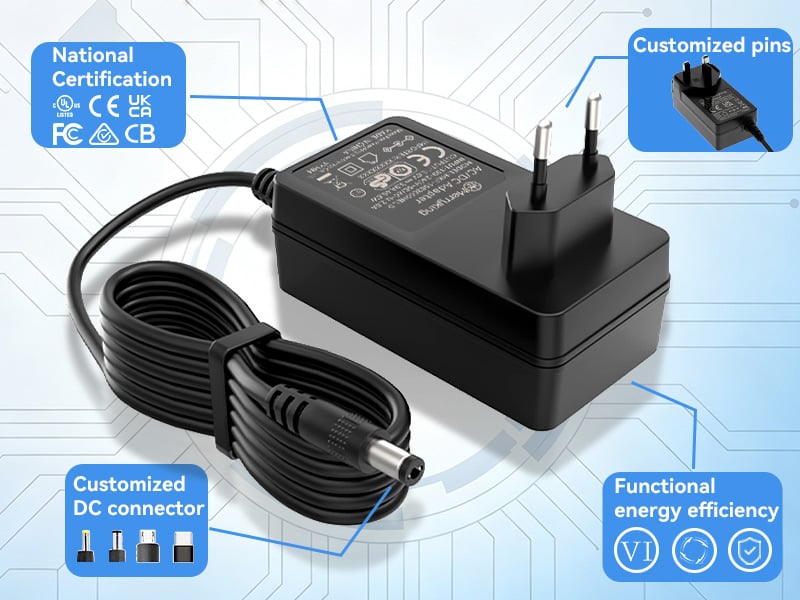
Off-the-shelf power adapters are designed to serve the broadest possible range of applications, which means they represent a compromise between versatility and specificity. Product designers frequently encounter situations where a standard adapter's voltage, current rating, connector type, cable length, or plug configuration does not match their device's requirements. Custom power adapter advantages become apparent when a product has unique power specifications, operates in a specialized environment, or needs to comply with specific regional regulations that standard catalogs cannot address. A custom adapter is engineered to match the exact electrical, mechanical, and regulatory requirements of a specific product, eliminating the need for workarounds such as voltage converters, adapter cables, or connector adapters that introduce reliability risks and additional cost.
The most fundamental custom power adapter advantages relate to electrical specifications. While standard adapters offer common voltage outputs such as 5V, 9V, 12V, and 24V, a custom adapter can be engineered for non-standard voltages such as 8V, 13.5V, 15V, 18V, 29V, or 48V to match specific device requirements. Current output can be tailored precisely to the device's draw profile, avoiding the inefficiency of over-rated adapters or the risk of under-rated units. Connector customization is equally important: standard barrel jack sizes include 5.5mm x 2.1mm and 5.5mm x 2.5mm, but some devices require proprietary connectors, DIN connectors, aviation-grade circular connectors, or specific USB-C configurations with custom pin assignments. Cable length can be specified to match the installation environment, from short 0.5-meter cables for compact devices to 3-meter or longer cables for wall-mounted displays and ceiling-mounted equipment. Shielded cable options are available for applications in electrically noisy industrial environments where electromagnetic interference could affect signal integrity.
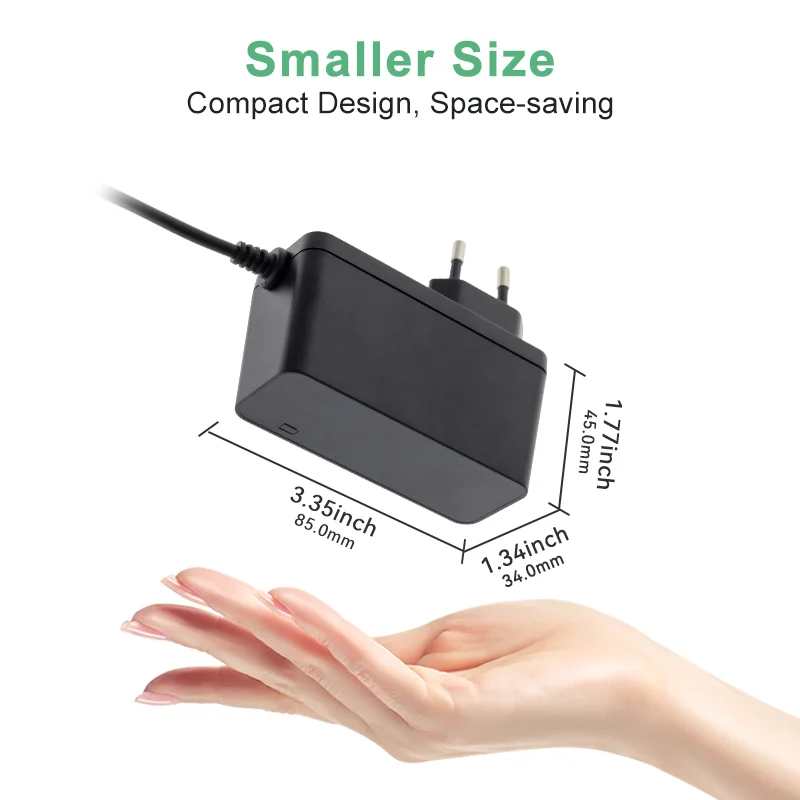
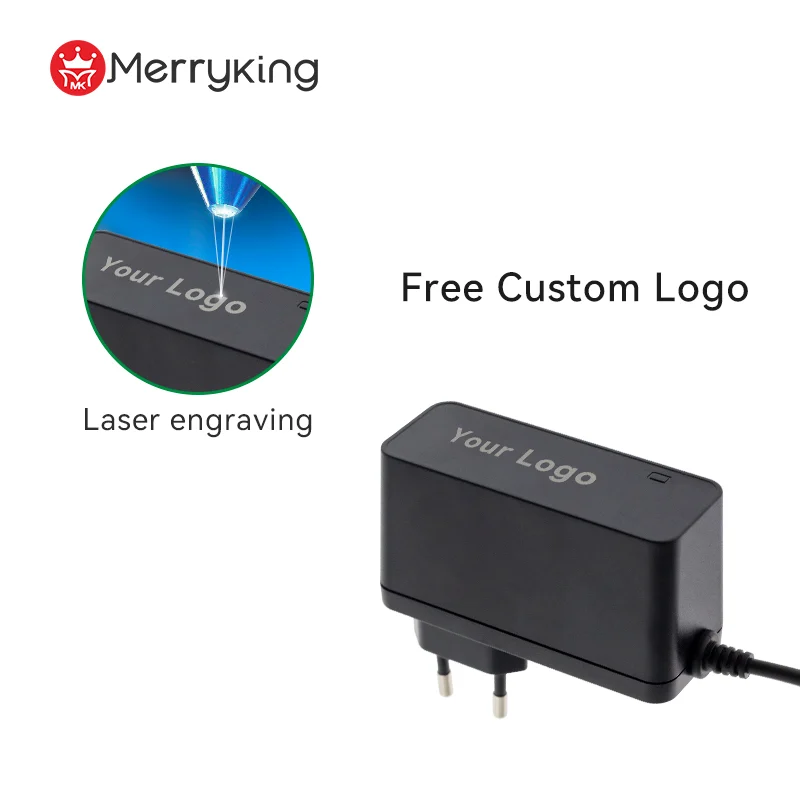
Custom power adapter advantages extend to the mechanical design of the adapter housing and plug system. For products sold in multiple regions, an interchangeable plug system allows a single adapter body to accept different plug types including EU (CEE 7/16), US (NEMA 1-15), UK (BS 1363), AU (AS/NZS 3112), CN (GB 2099), AR (IRAM), KR (KSC 8305), JP (JIS 8303), and IN (IS 1293) configurations. This approach reduces inventory complexity by using one adapter SKU with snap-on plug attachments rather than stocking separate adapters for each market. Housing customization includes color matching to the product brand, logo placement via silk-screen printing or embossing, and form factor adjustments such as slim-profile designs for space-constrained installations. For medical applications, custom adapters can meet IEC 60601-1 safety standards with enhanced patient leakage current limits and reinforced insulation. Industrial applications may require IP-rated housings for dust and moisture resistance, vibration-resistant internal construction, or extended operating temperature ranges from minus 20 to plus 70 degrees Celsius.
One of the most significant custom power adapter advantages is the ability to engineer for multi-region regulatory compliance from the outset. A custom adapter can be designed to carry multiple certification marks simultaneously, including UL and ETL for North America, CE-LVD and CE-EMC for Europe, UKCA for the United Kingdom, PSE for Japan, KC and KCC for Korea, SAA and RCM for Australia, BIS for India, and S-MARK for Argentina. This consolidated compliance approach eliminates the need to source different adapters for different markets, simplifying supply chain management, reducing SKU count, and ensuring consistent product quality across all regions. The certification process for a custom adapter typically takes 6 to 12 weeks, during which the design is finalized, prototypes are tested, and certification documentation is prepared. Manufacturers who already hold active certifications across these regions can leverage existing test reports and factory inspection records to accelerate the certification timeline for new custom models.
A medical device company developing a portable patient monitoring system required a power adapter that met IEC 60601-1 medical safety standards with a patient leakage current limit below 100 microamperes, compared to the 250-microampere limit for standard IT equipment under IEC 62368-1. The device operated at 15V and drew 1.2A continuously, with peak draws of 1.8A during sensor activation. Standard medical adapters in the 15W category were available with EU and US plugs, but the product needed UK and AU plugs for planned market launches. The engineering team partnered with a custom adapter manufacturer who held sixteen international safety certifications including medical-grade approvals. The custom development process took 10 weeks: two weeks for electrical design and prototype assembly, four weeks for safety testing against IEC 60601-1, and four weeks for certification issuance. The resulting adapter featured a white housing matching the device's clinical aesthetic, interchangeable plug heads for four regions, and reinforced double insulation meeting the medical standard's creepage and clearance requirements. The consolidated certification package allowed the device manufacturer to launch simultaneously in all target markets without sourcing separate adapters per region.
Evaluating custom power adapter advantages requires comparing total cost of ownership against standard alternatives. Custom adapters typically involve a one-time tooling and design fee ranging from 3,000 to 15,000 USD depending on complexity, plus a minimum order quantity of 1,000 to 5,000 units. Per-unit pricing is competitive with standard adapters at volumes above 5,000 units because the custom design eliminates unnecessary features and optimizes component selection for the specific application. The cost savings from reduced SKU count, simplified customs clearance (one certification package instead of multiple region-specific ones), and eliminated adapter accessories (converter cables, plug adapters) often offset the initial investment within the first production run. For products with expected annual volumes above 10,000 units, custom adapters frequently deliver lower total cost per unit than standard adapters when inventory management, certification maintenance, and warranty claim costs are factored in.
What is the minimum order quantity for a custom power adapter?
Minimum order quantities vary by manufacturer and complexity but typically range from 1,000 to 5,000 units for a fully custom design. For semi-custom modifications such as custom cable length, plug type, or logo printing on an existing certified platform, MOQs may be as low as 500 units. Manufacturers with established product platforms and active certifications can offer lower MOQs because the base design has already been certified.
How long does it take to develop and certify a custom power adapter?
The timeline from initial specification to certified production units typically ranges from 8 to 16 weeks. This includes 2 to 4 weeks for electrical and mechanical design, 4 to 8 weeks for safety testing and certification, and 2 to 4 weeks for production setup and first-article inspection. Manufacturers who already hold related certifications and have existing test relationships can often compress this timeline by leveraging existing test data and factory inspection records.
Can a custom adapter carry multiple regional certifications simultaneously?
Yes, a single custom adapter design can carry multiple certification marks including UL, CE, UKCA, PSE, KC, SAA, BIS, and others. The certification process involves testing against each standard's requirements, which share the common IEC 62368-1 baseline but have national variations. A well-designed custom adapter addresses all national variations in a single design, and the CB Scheme allows one test report to support multiple national certifications, reducing testing time and cost.