EN



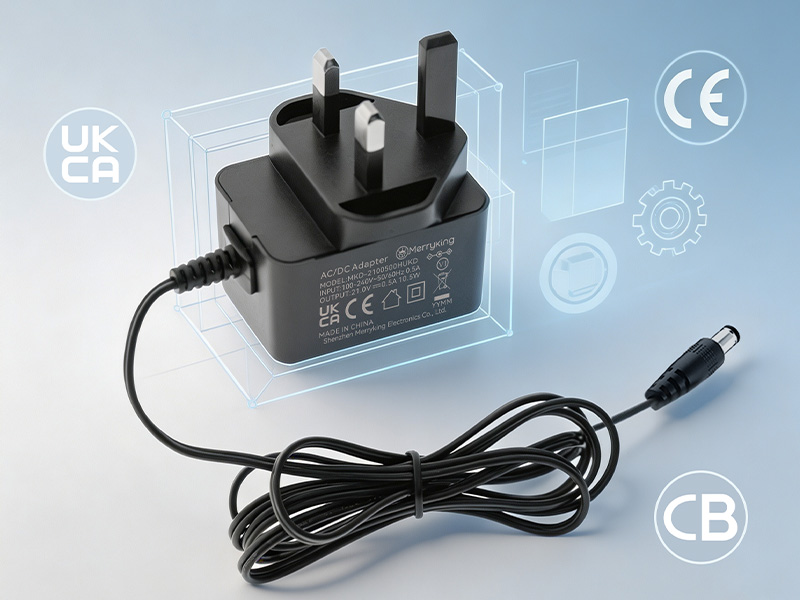
A custom power adapter starts with non-recurring costs that you pay once regardless of order quantity. Tooling is the first item: injection molds for a new housing, silk-screen plates for logos, and any fixture needed for automated testing. Engineering samples also carry cost, especially when the design requires a new transformer, PCB layout, or a modified control circuit. Certification is usually the largest one-time expense, because safety testing is performed by certified laboratories and the cost scales with the number of markets you target. A custom power adapter for North America needs UL or cUL and FCC testing; Europe adds CE and UKCA; Japan requires PSE; India requires BIS. If your design is close to a factory's already-certified platform, the factory may extend an existing certificate with targeted testing, which costs less than a full new certification program.
Once development is complete, each unit carries its own cost. Materials dominate: the transformer, control IC, capacitors, MOSFETs, housing, cable, and connector typically account for most of the unit price. Labor and manufacturing overhead follow, and their share depends on how automated the production line is and how the factory manages quality. Testing is a small but real component: a 100% aging test on every unit, AQL sampling inspection before shipment, and the calibration of test equipment all add to the unit cost. Efficiency also matters in the price, because higher-efficiency designs use better components and slightly different circuit topologies. When you compare quotes, ask for the material cost split and the testing plan, because a factory that skips the aging test can offer a lower price for a reason.
Order quantity is the lever that turns one-time costs into a per-unit burden. The same custom power adapter can cost one price at 500 pieces and a meaningfully lower price at 5,000 pieces, because tooling and certification are amortized over more units and the factory can buy components at better prices. This is why factories quote tiered prices and why buyers should forecast honestly. If your project is a one-time run of 500 units, the development cost may exceed the unit savings you get from a custom design. If your project is a recurring product line, the custom adapter pays for itself across thousands of units. Before approving a custom power adapter, calculate the total program cost at your realistic volume and compare it with the best standard alternative.
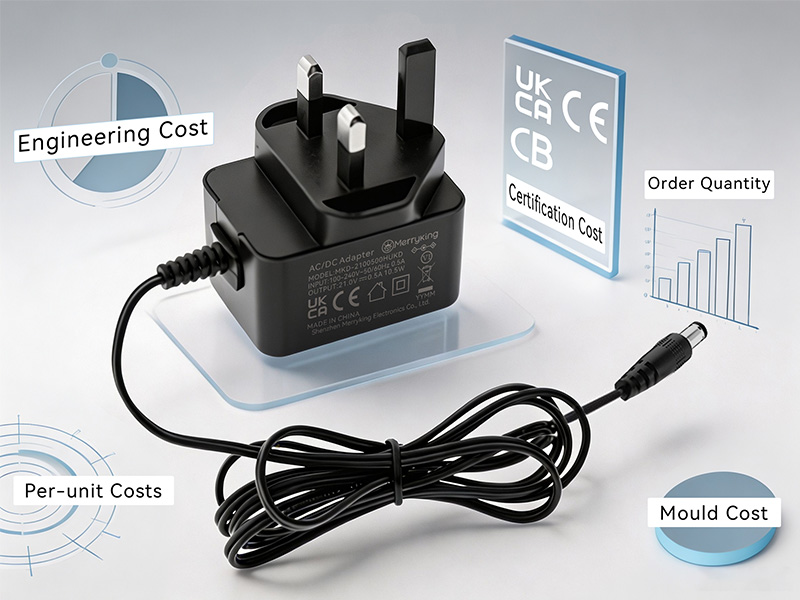
It also helps to understand where the factory's scale economies come from. At higher volumes, the factory can negotiate better prices for control ICs, transformers, capacitors, and connectors, because component suppliers offer volume discounts just as the factory does for its own customers. Production efficiency improves as well: a dedicated line for your model runs faster, changeover time between models disappears, and the yield improves because operators gain experience with the same product. Fixed costs such as equipment depreciation and testing fixtures are spread over more units. These effects are why the price difference between a 1,000-piece order and a 5,000-piece order is often larger than buyers expect. When you negotiate a custom power adapter program, ask the factory to explain the price curve at each tier, and confirm which cost elements actually decline at higher volumes. A price curve that only drops at unrealistic quantities is a sign that the quotation was padded for negotiation, while a curve that reflects real component and efficiency savings is a sign of a transparent partner.
An OEM was evaluating whether to develop a custom power adapter for a new point-of-sale terminal. The factory quoted a tooling fee, a certification fee for the target markets, and a unit price at three volume tiers. The OEM calculated the total program cost at 2,000 units per year over three years: the one-time costs spread across 6,000 units added a modest amount to each unit, and the per-unit price was only slightly above the factory's standard 24V adapter because the design reused a certified platform. The custom adapter gave the terminal a locked connector, a branded housing, and an exact output match, all for a small premium over the standard option. Had the project volume been 500 units, the same calculation would have favored the standard adapter. This scenario shows why cost should be evaluated as a program number, not a unit number.
To get a realistic custom power adapter quotation, give the factory a complete specification and your honest forecast. Include the electrical values, mechanical form, connector, environmental conditions, target certifications, and expected annual quantity. Ask the factory to separate the quote into one-time costs and per-unit costs, and to state the volume at which each price tier applies. Request a cost breakdown for the main materials and ask whether any component is subject to market volatility, because prices for control ICs and power semiconductors can move. Finally, confirm what is included in the unit price: packaging, testing, and inspection, or only the bare product. A transparent quote is the basis for a transparent program, and it protects both sides from surprises later.
Why is a custom power adapter more expensive than a standard model?
A custom model carries one-time costs that a standard model has already recovered: tooling, engineering, and certification. Until those costs are amortized across your order volume, the unit price will be higher than a catalog product with the same output.
What is the most expensive part of a custom adapter project?
For small volumes, certification is usually the largest one-time cost. For large volumes, materials dominate the total cost. The balance shifts with quantity, which is why the program-level calculation matters more than the unit price alone.
Can I reduce the certification cost of my custom adapter?
Yes, by reusing a factory's already-certified platform wherever possible, keeping the design close to the standard series, and limiting the number of target markets in the first production round. Each new market adds a new testing requirement.