EN
EN



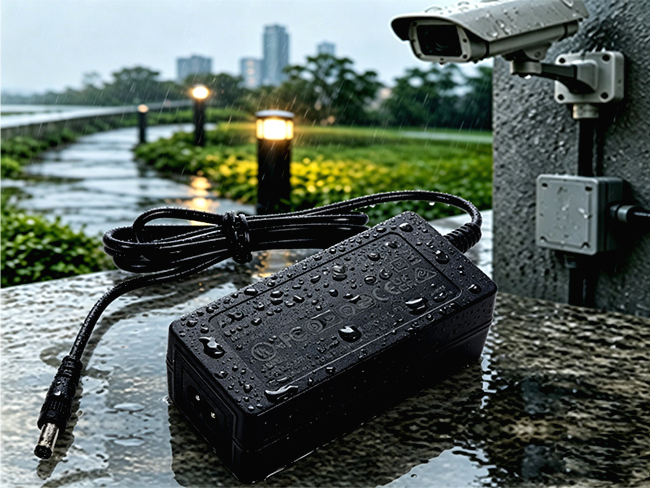
Selecting a reliable power supply for challenging environments requires a deep understanding of environmental protection and electrical safety. Whether you are deploying outdoor security cameras, landscape LED lighting, or industrial sensors, finding the right waterproof dc power adapter is critical to ensure stable performance, long service life, and safe operation. At Merryking, we draw upon years of specialized manufacturing experience to engineer AC/DC power solutions that bridge the gap between high-voltage grids and delicate equipment. For B2B buyers and project engineers, making an informed choice involves looking beyond surface-level specifications and analyzing how an adapter manages thermal stress, moisture ingress, and electrical regulation under volatile outdoor conditions.
The primary benchmark for evaluating any waterproof dc power adapter is its Ingress Protection rating, established by the International Electrotechnical Commission. An IP rating consists of two digits: the first measures protection against solid particles like dust, and the second measures resistance to liquids. For demanding outdoor or semi-outdoor applications, choosing an adapter with a certified IP rating helps indicate tested protection against dust and water under defined conditions, but it does not by itself guarantee protection against all humidity, driving rain, UV exposure, salt spray, cable aging, or installation errors. In exposed outdoor installations, standard indoor power bricks are not recommended because moisture ingress may increase the risk of insulation failure, corrosion, leakage current, short circuits, or fire. A professional outdoor adapter should use a properly sealed enclosure, suitable gasket or potting design, and cable sealing that are validated for the intended environment.
The output voltage of your waterproof dc power adapter should match the device's rated input voltage or fall within the input range allowed by the device manufacturer. Using an output voltage outside the allowed range can damage sensitive circuits, while insufficient voltage may cause unstable operation or startup failure. For current and wattage, the adapter's rated output should be equal to or greater than the maximum current required by the device, including startup or peak-load conditions where applicable. A 10% to 20% current headroom may be used as a practical engineering guideline when the application allows it, but it should not be attributed to UL, IEC, or ITU-T unless a specific standard number and clause are cited. Appropriate derating can help reduce internal temperature and thermal stress, but the required margin depends on ambient temperature, load profile, cable loss, enclosure design, and the adapter derating curve.
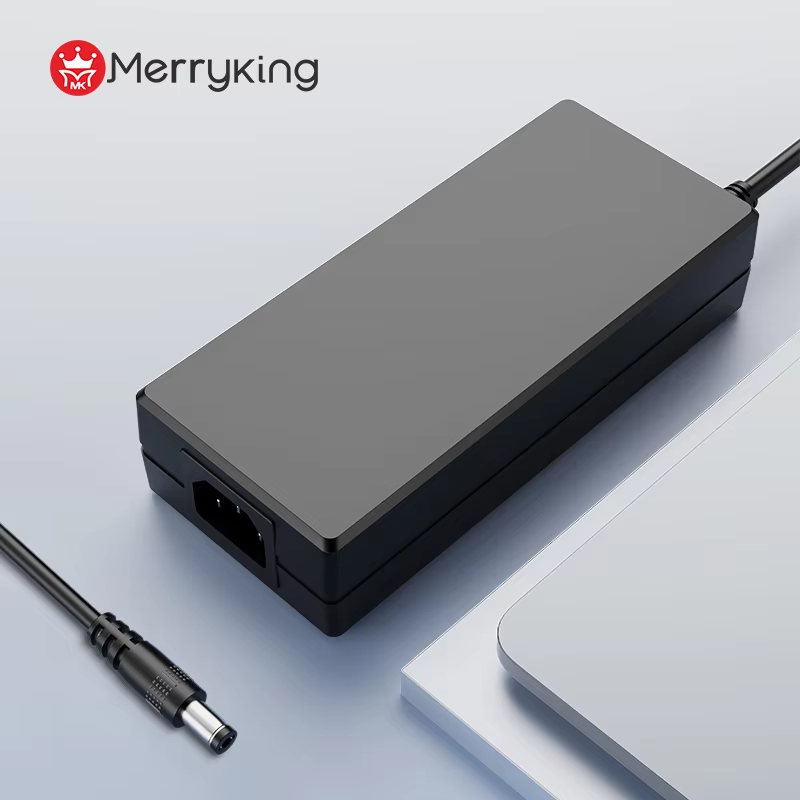
Safety is a key consideration when dealing with outdoor electrical installations where moisture can increase the risk of shock, leakage current, corrosion, or fire. When reviewing technical specifications for a waterproof dc power adapter, buyers should distinguish safety approvals from EMC, environmental, energy-efficiency, and market-conformity requirements. UL/cUL, ETL, GS, PSE, CCC, KC, SAA, or CB-based national approvals may relate to safety, depending on the exact model and target market; CE and UKCA are market conformity marks, FCC is mainly related to U.S. electromagnetic compatibility or radio compliance, RoHS relates to restricted substances, and DOE Level VI relates to external power supply efficiency where applicable. Furthermore, a quality adapter should include appropriate protection functions for the intended application. These may include Over Voltage Protection, Over Current Protection, Short Circuit Protection, Over Temperature Protection, and in some models Over Power Protection. These functions can help reduce damage risk under defined fault conditions, but thresholds, response time, surge immunity, and recovery behavior must be confirmed from the datasheet and test reports.
While internal electrical configurations are vital, the physical and mechanical interface often determines the long-term viability of an outdoor deployment. An outdoor waterproof dc power adapter must feature high-quality input and output cables that resist UV degradation, extreme temperature fluctuations, and mechanical wear. In long-term outdoor use, low-grade cable jackets may crack under sunlight, freezing temperatures, or repeated bending, allowing moisture to migrate toward the connector or housing. B2B buyers should specify jacket materials, cable length, wire gauge, connector rating, polarity, and DC plug dimensions, such as 5.5x2.1mm or 5.5x2.5mm, according to the actual equipment requirement. This mechanical compatibility helps reduce the risk of loose connections, voltage drops, heating, and electrical arcing in humid or vibration-prone environments.
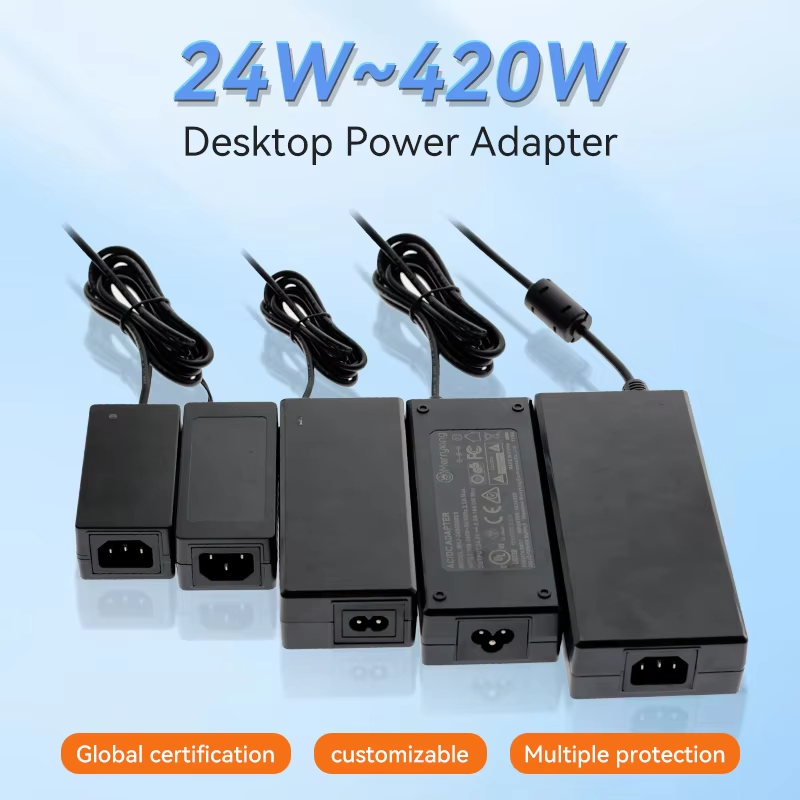
Heat remains the primary enemy of electronic components, and managing it becomes even more complex when a power supply is completely sealed against water. For most outdoor adapter applications, a high-efficiency switching power supply topology is preferred because it reduces heat generation and size compared with typical linear supplies, although linear supplies may still be used in selected low-noise applications. Modern switching adapters may be designed to meet applicable energy-efficiency requirements, depending on model, output rating, and target market. When a sealed adapter operates efficiently and within its rated load and ambient temperature, natural convection cooling may be sufficient without a fan. For continuous 24/7 operation, especially inside an enclosed or unventilated outdoor cabinet, buyers should confirm the derating curve, maximum case temperature, ambient temperature limit, mounting direction, ventilation, and expected load duty cycle.